
How to Find the FX Revenue in Your Bank's Wire Data
Your wire data already shows how much FX your business clients do elsewhere. What to look for, how to size the opportunity, and what to do next.

Most community banks and credit unions are losing FX revenue they can't see. The good news is that you can find it in your own wire data, and you don't need a consultant or a new system to do it.
After more than 15 years in FX and cross-border payments, I've seen the same signs show up again and again in banks' wire data. This post explains what they look like, how to put a number on them, and what to do once you have it.
Why the opportunity is easy to miss
When a business client needs to pay a supplier overseas and its bank doesn't offer FX, or doesn't offer it at a competitive rate, the client finds someone who does. It sends US dollars to that provider, and the provider converts the currency, pays the supplier, and earns the FX revenue. All the bank sees is what looks like an ordinary USD wire going out.
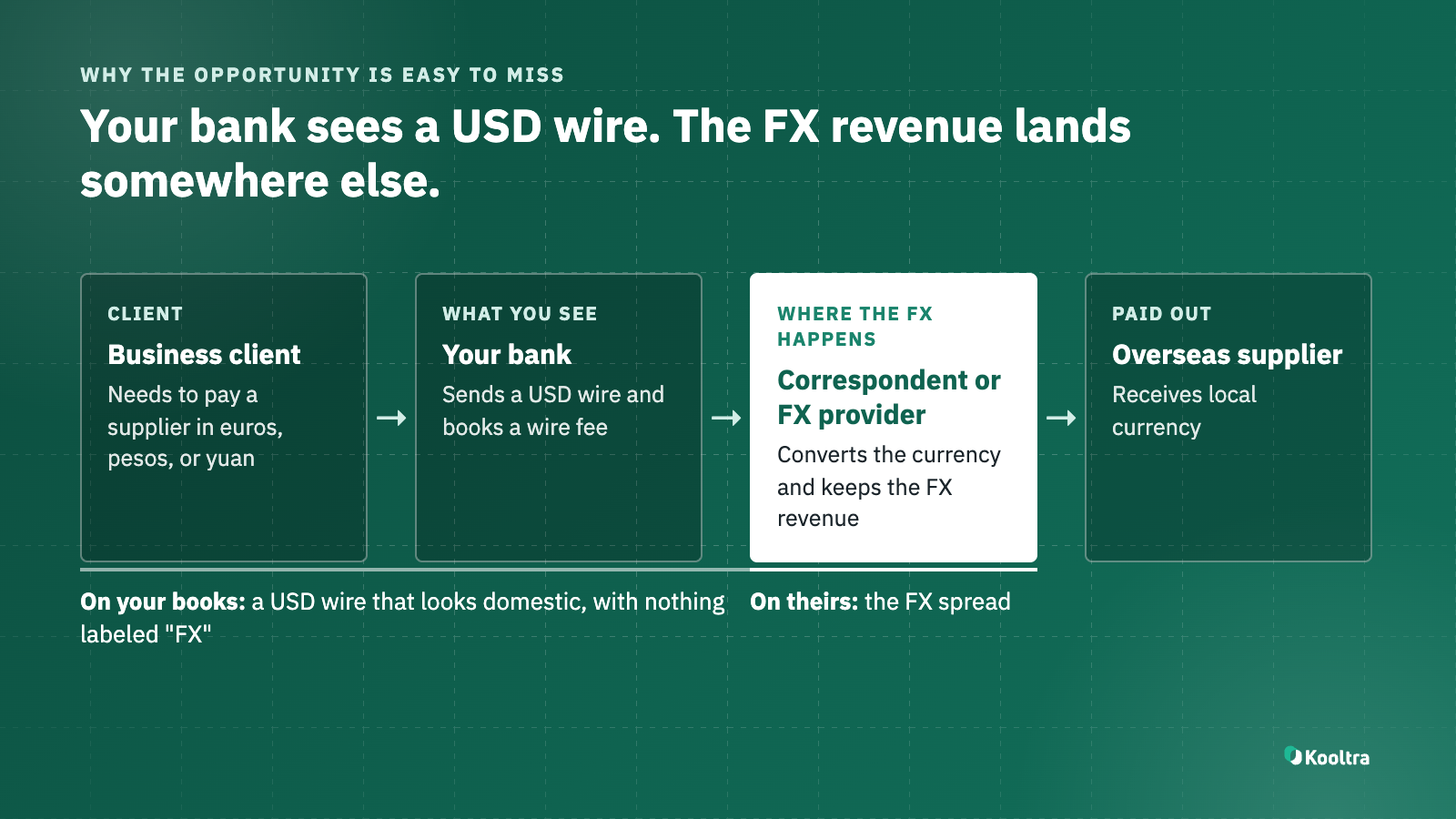
The provider is usually an FX specialist, a payments company, or a bigger bank. The bank may well know the client does business overseas. What it rarely sees is how much FX volume those transfers carry, how much revenue it's missing by not offering the service, and what goes with those payments: the balances, the day-to-day relationship, and eventually the next loan.
Some of that FX does run through the bank. When the bank sends an international wire through a correspondent, the correspondent handles the conversion and keeps most of the spread. The bank knows those are FX payments, but it rarely adds up how much revenue they represent. Neither kind of payment shows up as FX revenue on the bank's reports, which is why so many banks underestimate how much international business their clients do and what that business could earn.
What to look for in your wire data
It comes down to one signal: a business client sending US dollars to an account in its own name somewhere else, where the currency conversion happens. Two details tell you what you're looking at: where the money goes, and how often it goes.
1. Where the money goes
Look for wires where the sender and the beneficiary are the same business, such as ABC Corp sending US dollars to ABC Corp's own account at Wise, Airwallex, Corpay, Convera, or OFX. The beneficiary bank tells you who is handling the client's FX. The same transfer to an account in the client's name at a larger bank usually means that bank is handling the international payments you aren't offering.
2. How often it goes
Then look at the timing. The same round amount, sent on about the same day each month, usually means the client pays suppliers or staff overseas on a schedule, which is steady FX volume you can count on. One-off or irregular transfers usually line up with larger purchases or projects. Both count toward the opportunity, but recurring transfers are the easiest to bring back to your bank because the need comes up every month.
How to size the opportunity
You don't need an FX specialist to run this analysis, because someone in wire operations or finance can do it in a spreadsheet or with the AI tool of your choice.
- Pull the last 12 months of outgoing wire data, including the beneficiary name, beneficiary bank, amount, and date.
- Flag transfers to clients' own accounts at FX providers, payments companies, and other banks, and mark each one as recurring or one-off.
- Add up the annual volume by client, so you can see which relationships carry the most international activity.
- Multiply the total by the margin you could earn, which is generally around 1% on business FX payments.
- Rank the clients by opportunity. A short list of names is more useful than one big number, because it tells your relationship managers where to start.
If you'd rather not do the matching by hand, an AI tool can do it for you. Use one your bank has approved for customer data, because wire records include client names and account details. Here's a prompt to start with:
I've attached 12 months of our bank's outgoing wire data. Each row has the date, amount, originator name, beneficiary name, beneficiary bank, and beneficiary account. Please find the following:
1. Wires where the originator and the beneficiary are the same business (or the names closely match), sent to an account at an FX provider or payments company such as Wise, Airwallex, Corpay, Convera, or OFX, or at another bank.
2. For each of those, whether the transfers are recurring (a similar round amount on about the same day each month) or one-off.
For each client that matches, show the total annual volume, the number of wires, the receiving institution, and whether the transfers are recurring or one-off. Then estimate the annual revenue at a 1% margin, and rank the clients from the largest opportunity to the smallest in a table.
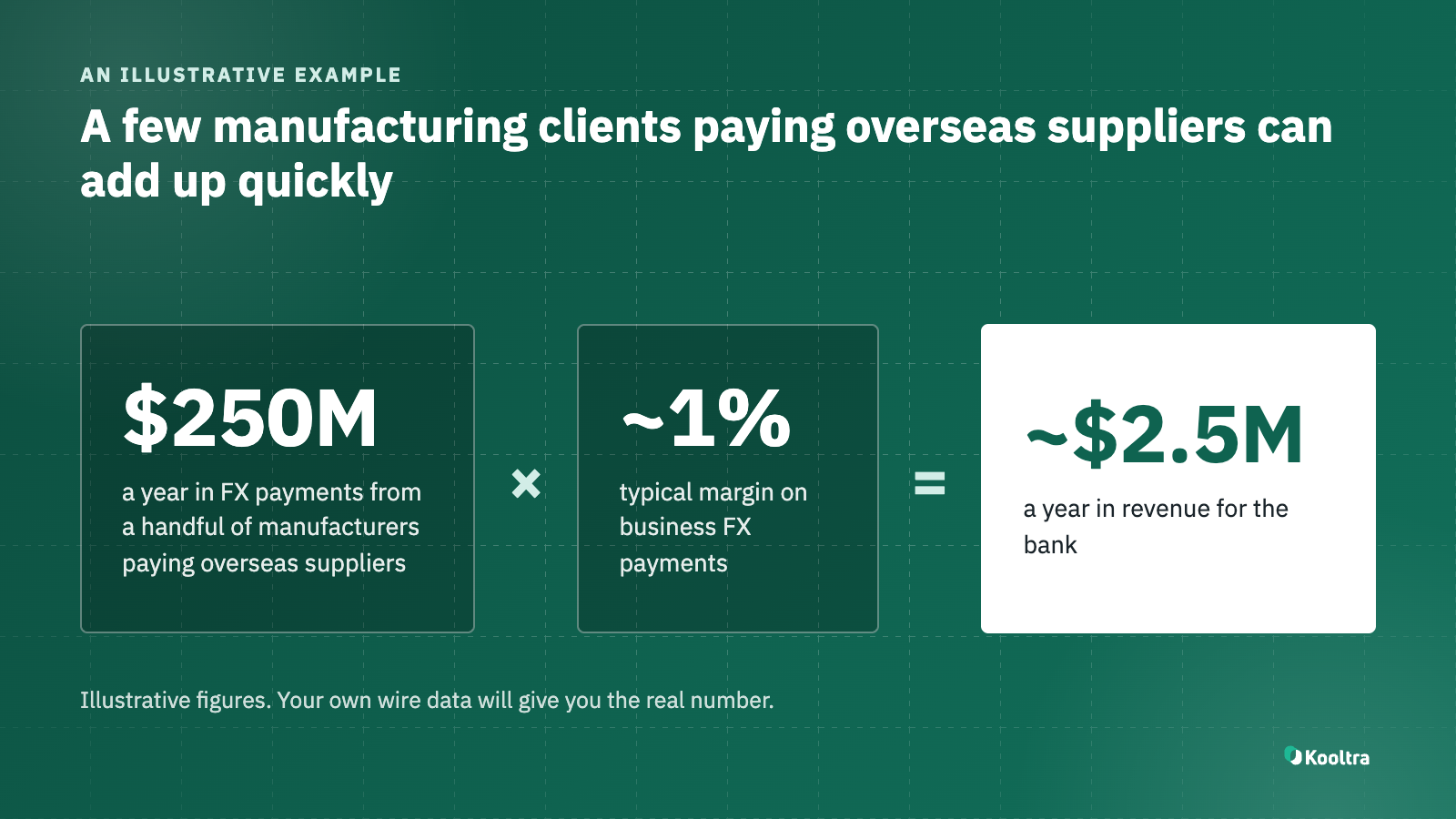
A few manufacturers paying suppliers overseas can easily add up to $250 million a year in FX payments. At a margin of about 1%, that's around $2.5 million a year in revenue for the bank.
Those figures are illustrative, and your own wire data will give you the real number.
Revenue is only part of the picture
The fee and spread income is the easiest part to measure, but it isn't the only benefit. When a bank handles a client's international payments, the balances that fund those payments stay at the bank. The bank also stays first in line for the client's next loan, and its relationship managers have a reason to talk to the client every month instead of once a year at renewal.
Those benefits reinforce each other. A client that runs its international payments through your bank has fewer reasons to open an account at a fintech or a larger bank, and the relationship gets stronger every time your team helps it pay a supplier. That's why offering FX and cross-border payments at your bank is about more than the revenue on any single wire, and why the clients at the top of your list are worth a conversation even if their volume looks modest today.
What to do with the number
Once you know the size of the opportunity, the next steps are practical:
- Talk to the clients at the top of the list. Ask how they pay overseas today, what it costs them, and what it would take for them to move those payments to you.
- Decide who owns FX at the bank. It could sit in commercial banking, treasury, or operations, but it needs one owner.
- Bring your compliance team in early. They'll want to understand how clients are onboarded and screened and how payments are monitored.
- Start with one service, such as outbound international payments, and add others once it's running well. Expansion opportunities include receiving payments from overseas customers, holding balances in foreign currencies, and forward contracts that let clients lock in an exchange rate for future payments.
How Kooltra helps
Kooltra is the software that runs FX and international payments for banks, credit unions, fintechs, and payment businesses. We don't move your money or compete for your clients. We're the infrastructure underneath, running next to the systems you already use.
- 12 years in FX and cross-border payments, with more than $500 billion in annual FX and more than $50 billion in annual payments processed for our clients.
- Onboarding, compliance, dealing, payments, and reporting in one platform, so screening and reporting happen as part of the workflow instead of by hand.
- Live in under six weeks on average from kickoff.
If you've run the numbers on your own wire data and want to talk through what you found, send me a message on LinkedIn, or book a strategy call with our team.
Frequently asked questions
How can a bank tell if its clients are making international payments elsewhere?
Look at outgoing wire data for USD transfers from business clients to accounts in their own names at FX providers, payments companies, or larger banks. Recurring, round transfers usually mean scheduled supplier payments, and one-off transfers usually line up with larger purchases. Either way, the client is paying overseas through someone else.
How much can a bank earn on FX payments?
Margins vary by client and payment size, but a bank can generally earn around 1% on business FX payments. A small group of clients making international payments can add up to meaningful annual revenue.
Does a bank need an FX specialist to size the opportunity?
No. The analysis uses wire data the bank already has. Someone in wire operations or finance can pull 12 months of outgoing wires, flag transfers to clients' own accounts elsewhere, and multiply the annual volume by the margin the bank could earn.
What data does a bank need for the analysis?
Twelve months of outgoing wires with the beneficiary name, beneficiary bank, amount, and date are enough to start.

SUBSCRIBE TO OUR CONTENT


