
Why FX and Cross-Border Payments Belong at Your Bank
Kooltra President Stephen Best on why FX and cross-border payments belong at regional and community banks: what FX does for a bank, what it takes, and where to start.

Ask a regional or community bank why it doesn't offer FX or cross-border payments and you'll usually hear some version of "we're too small," "it's too risky," or "it's too complicated to set up."
After more than three decades in FX and financial markets technology, I think the bigger risk is not offering it. When a business client needs to pay a supplier overseas and their bank can't help, they don't just take that one payment elsewhere. Over time, the relationship and the deposits follow.
This post is for the banks and credit unions weighing that decision: what offering FX and cross-border payments does for a bank, what it actually takes, and how to start without standing up a trading desk.
What happens when your bank can't help
Most regional and community banks already move money internationally for their clients. They send a wire through a correspondent, often a bankers' bank, and the correspondent handles the FX. The bank keeps a small share of the revenue, the client pays a wide spread, and nobody at the bank owns the relationship.
That worked when business clients had few alternatives, but now they have plenty. Payment fintechs have made international payments fast, transparent, and easy to set up, and they market directly to the same small and mid-sized businesses that bank with you.
Once a client opens an account somewhere else to pay suppliers, balances start to sit there too. The client who used to call you about every part of their banking now has a second financial relationship, and the next conversation about a loan or treasury services may not be with you.
In my experience, the opposite is also true: when a bank offers the service well, most business clients would rather keep their international payments with the bank they already trust.

Four things FX does for a bank
Done well, FX and cross-border payments do more than earn a fee on each wire. Here are four ways they strengthen a bank's commercial business.
1. Non-interest income, without using the balance sheet
FX and international payments earn fee and spread income that doesn't depend on lending. For a bank under pressure on margins, that's revenue that doesn't consume capital or add credit risk. It's also one of the few sources of non-interest income that grows with your commercial clients' business.
2. Deeper, better-protected commercial relationships
Business clients that import, export, or pay overseas staff need international payments every month. Serving that need puts your bank at the center of how they run their business, rather than making it one provider among several. It also protects the relationship from the fintechs marketing to the same clients.
3. Deposits that stay
When clients move their international payments elsewhere, the balances that fund those payments tend to move too. Bringing the payments in-house keeps those deposits on your balance sheet.
4. A reason to call your best clients
Relationship managers need reasons to talk to clients beyond loan renewals. FX gives them a useful one: helping a client pay suppliers more simply, at a fair price, through their own bank.
Two starting points, one goal
Everything above applies whether or not a bank offers FX today. A bank that runs FX on older systems, with manual steps and spot-only pricing, faces the same risk as a bank that doesn't offer it at all: its clients compare the service with what fintechs offer them, and they move when the bank falls short. That's why, when I talk with banks about FX, I don't start with how big they are. I ask whether they offer it today and, if they do, whether it's competitive with what a fintech offers their clients.
- Banks that already run FX usually need to modernize: older systems, manual steps between the front and back office, spot-only pricing, and a small team stretched thin. The question is how to do more with what they have.
- Banks that don't offer FX yet are making a different decision: whether to introduce a new offering at all, with the compliance, risk, and staffing questions that come with it.
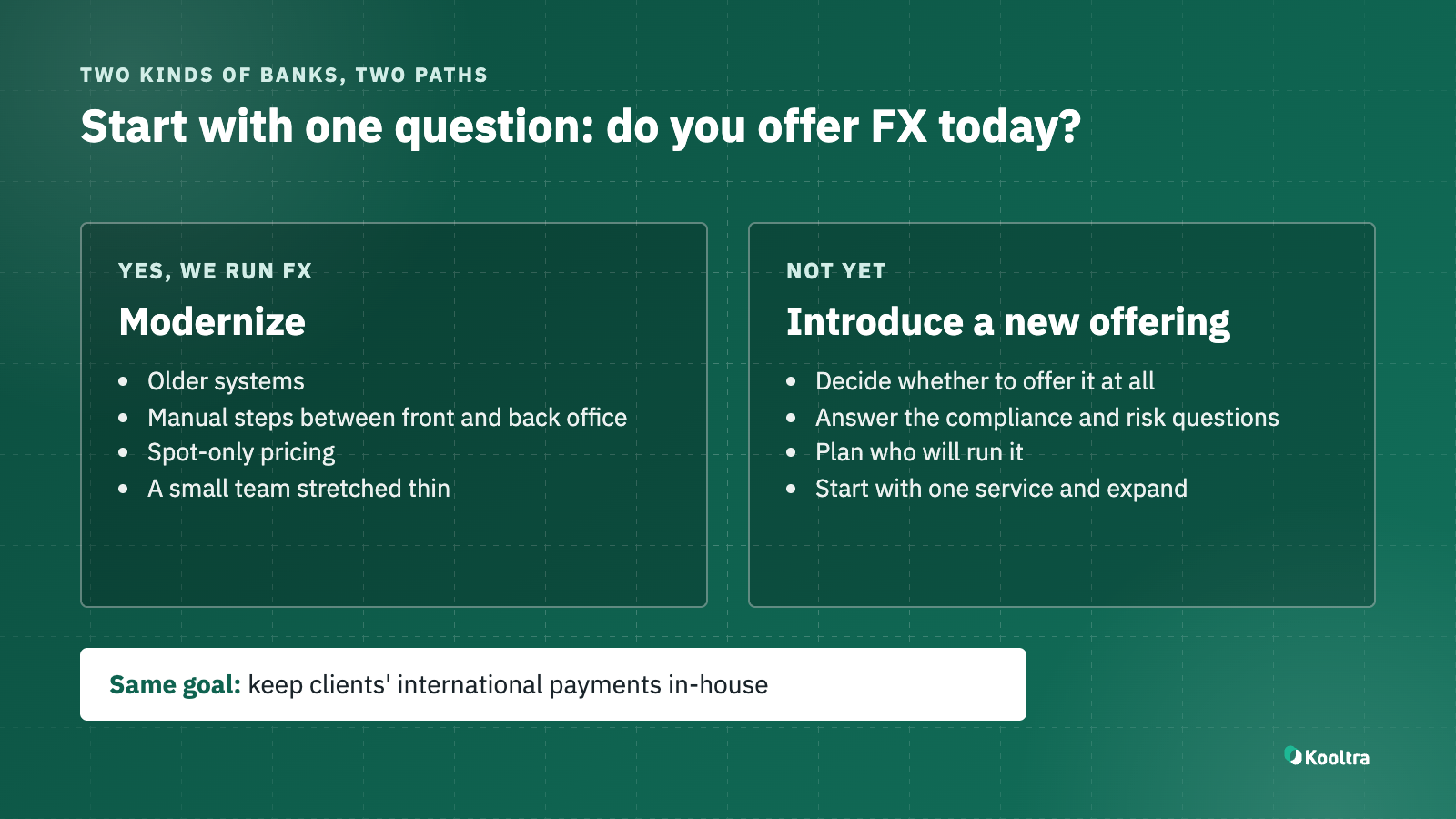
Either way, the goal is to keep clients' international payments in-house, but the path, the risks, and the business case are different. A vendor that treats them as one market will lose a careful bank's trust quickly.
What it actually takes
Whether you're modernizing or starting fresh, it's less complicated than it sounds: you don't need your own FX desk to offer FX and cross-border payments, but you do need four things.
The right partner
Look for a partner that knows FX and international payments as its core business, works alongside the systems you already run, can replace manual steps without a core conversion, and can show you how other regulated businesses use its platform day to day.
A clear path through compliance
Adding international payments changes a bank's risk profile. Your compliance team will want to understand how clients are onboarded and screened, how payments are monitored, and what reporting looks like. The right setup makes those workflows part of the process rather than something your team does by hand.
People who know FX
FX and payments expertise is scarce, especially at smaller institutions. At Sibos this year, a RedCompass Labs survey of US banks found that 58% of respondents blamed a shortage of payments expertise for the widening gap between small and large banks. A partner should bring that expertise with it, so your team isn't learning FX on the job.
Someone who owns it
The technology is the easier part. What sets successful banks apart is deciding who owns FX, how relationship managers are trained and rewarded for bringing it up, and which clients to start with. Without an owner, even a good product sits unused.
Questions to ask before you start
Before you talk to a vendor, it helps to answer a few questions inside the bank. These five will show you where you're starting from and what you'll need.
- Which of our commercial clients already make international payments, and how are they doing it today?
- Who at the bank will own FX and international payments: commercial banking, treasury, or operations?
- What will our compliance team need to see before we launch?
- Are we modernizing an FX business we already run, or introducing a new one?
- Do we want to start with one service, such as outbound payments, and expand from there?
How Kooltra helps
Kooltra is the software that runs FX and international payments for banks, credit unions, fintechs, and payment businesses. We don't move your money or compete for your clients. We're the infrastructure underneath, running next to the systems you already use.
- Onboarding, compliance, dealing, payments, and reporting in one platform, so screening and reporting happen as part of the workflow instead of by hand.
- 12 years in FX and cross-border payments, with more than $500 billion in annual FX and more than $50 billion in annual payments processed for our clients.
- Live in under six weeks on average from kickoff.
- A team that knows FX, so you have experts on the other end of the phone.
If you're weighing whether FX and cross-border payments belong at your bank, I'd be glad to talk it through. Send me a message on LinkedIn, or book a strategy call with our team.

SUBSCRIBE TO OUR CONTENT


